Pacific Palisades View vs Village: Find Your Best Fit
June 18, 2026
June 18, 2026
If you are torn between a Pacific Palisades home near the Village and one tucked into the hills, you are asking exactly the right question. These two lifestyles can feel very different, especially now, as the Palisades continues its post-fire recovery and buyers weigh not just beauty, but daily function, resilience, and long-term fit. This guide will help you compare convenience, privacy, architecture, and practical due diligence so you can choose with more clarity. Let’s dive in.
Pacific Palisades is still rebuilding after the Palisades Fire, and that matters for every buyer decision. The City of Los Angeles says recovery efforts are focused on rebuilding homes, restoring infrastructure, and preserving community character, with streamlined processes intended to help move that work forward.
That broader recovery context shapes both sides of the Village-versus-view conversation. A home here is not just about location and style right now. It is also about how a property sits within a community that is actively recovering, reopening, and adapting.
One especially important detail is the status of Palisades Village. The official site says the center is temporarily closed and scheduled to reopen in August 2026, so any buyer considering a more walkable Village lifestyle should factor in that the area’s commercial rhythm is still in transition.
If you want a more pedestrian daily routine, Village-adjacent homes often make the most sense. The Brentwood-Pacific Palisades Community Plan identifies the Pacific Palisades Commercial Village and nearby corridors as pedestrian-oriented areas, which helps explain why some addresses feel more errands-on-foot and neighborhood-centered.
The Pacific Palisades Commercial Village and Neighborhoods Specific Plan reinforces that pattern. It is designed to support community-oriented commercial uses, enhance pedestrian orientation, and shape storefront and parking design around foot traffic rather than a purely auto-first experience.
In simple terms, this part of the Palisades tends to offer a shorter daily rhythm. You may be closer to shops, services, and a more active street environment, even though the Village itself remains temporarily closed as of mid-2026.
Village-adjacent homes often appeal to buyers who value convenience and a sense of neighborhood activity. If you like the idea of being close to the commercial core and want a lifestyle with less driving built into every small task, this option can feel easier and more connected.
This can also suit buyers who want a more traditional neighborhood-center experience rather than a property defined primarily by terrain or seclusion. In the Palisades, that often means the home is part of a broader local rhythm rather than set apart from it.
The same qualities that create convenience can also create tradeoffs. Homes closer to pedestrian-oriented commercial areas may offer less separation from daily activity and less of that tucked-away feeling some buyers want.
That does not make them less desirable. It simply means the payoff is different: more access and street life, with somewhat less privacy and retreat than you may find in hillside settings.
Hillside and view homes in Pacific Palisades usually deliver a very different experience. The community plan describes much of the area as low- and very-low-density single-family housing woven through rolling topography, which is a big part of why these properties can feel private, scenic, and deeply tied to the land.
For many buyers, this is the emotional draw of the Palisades. A hillside home often offers outlooks, landscape drama, and a stronger sense of separation, whether that means ocean-facing vistas, canyon edges, or architecture shaped by slope and light.
The planning framework also places clear emphasis on preserving views and keeping hillside development visually subordinate to natural terrain. That helps explain why these homes often feel more site-specific and more connected to the setting itself.
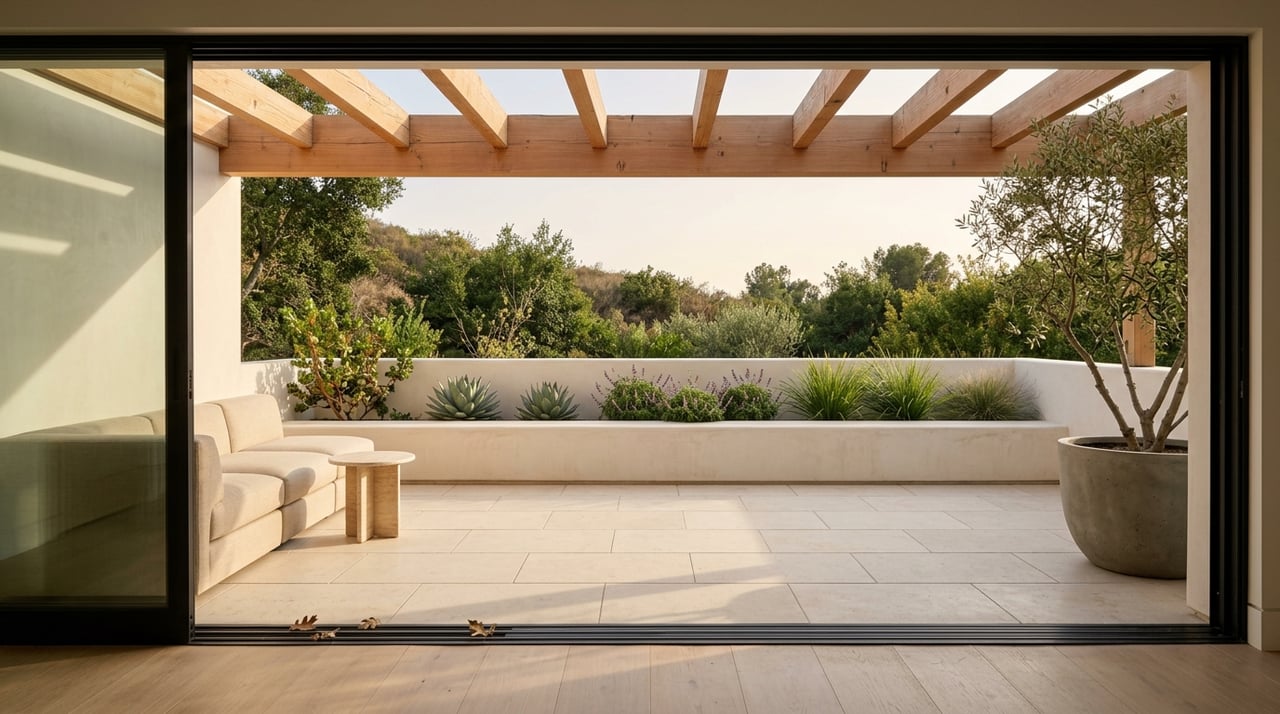
If you prioritize privacy, outlook, and a calmer atmosphere, hillside or view properties may be the better match. These homes often reward buyers who want a retreat-like environment and appreciate a stronger relationship between architecture and landscape.
This side of the Palisades can be especially appealing if you are drawn to design-forward homes, bluff-side siting, or modern and midcentury architecture that uses the lot in a distinctive way. In many cases, the setting is not just a backdrop. It is part of the home’s identity.
Hillside beauty usually comes with more complexity. The community plan says hillside development must account for street circulation, drainage, fire protection services, topography, and geology, which means buyers need to think beyond views alone.
For certain bluff lots, City Planning says a bluff analysis must be prepared by a California-licensed professional engineer or geologist, and development must be set back from the natural bluff edge. So while hillside homes may offer the strongest privacy and scenery, they often require more property-specific review before you move ahead.
One of the most common misconceptions about Pacific Palisades is that “close to the Village” is always a simple yes-or-no category. In reality, walkability changes quickly by address.
The city’s planning documents make clear that pedestrian orientation is strongest in the Village core and nearby corridors. Homes just outside that area may still feel close on a map, but your day-to-day routine can shift meaningfully depending on the exact block, street pattern, and terrain.
That is why it helps to think in terms of lived rhythm, not just distance. A property can be technically near the Village and still feel very different from one embedded in the most pedestrian-oriented section.
Before the fire, some buyers may have assumed Village living came with a fully operating commercial center at the heart of daily life. In 2026, that assumption needs updating.
Because Palisades Village is officially scheduled to reopen in August 2026, the Village-adjacent lifestyle is still partly a future-facing decision. You are buying into an area with a strong pedestrian planning framework and an established commercial role, but also one that is currently in a transition period.
That does not weaken the case for Village homes. It just means your timeline and expectations should reflect present-day conditions rather than pre-fire memory.
Wildfire is not a side note in Pacific Palisades. It is central to how buyers should evaluate property fit, especially in hillside settings.
CAL FIRE says fire hazard severity maps are based on factors such as terrain, vegetation, fire history, and fire weather. In a community like Pacific Palisades, those conditions make home-specific wildfire review especially important when comparing properties with different siting, access, and surrounding landscape.
The City of Los Angeles also says its Bureau of Engineering is still working on debris removal, hillside damage assessment, and permit support related to the 2025 fires. For buyers, that means resilience, recovery status, and property-level due diligence should be part of the conversation from the start.
Pacific Palisades does not read as one single design language. Its residential identity is layered, and that is part of what makes the choice between Village and view homes feel so personal.
In Huntington Palisades, early planning included curved streets, broad entries, landscaped parkways, and lots positioned for ocean and mountain views. Historic homes there reflect classic Southern California influences, including Monterey Revival, Spanish Provincial, and Andalusian character.
Other areas tell a different story. Castellammare was planned with steep roads, hillside stairways, and Italian Renaissance or Mediterranean design influences, while the Palisades also includes notable modernist and midcentury homes such as the West House, also known as Case Study House #18.
A helpful way to think about this is simple. Village-adjacent homes often feel more neighborhood-scaled and historically layered, while hillside and bluff homes are more likely to feel architect-driven, dramatic, and shaped by the lot itself.
If you are choosing between these two lifestyles, try focusing on how you want your days to feel rather than chasing a generic idea of “best.” In Pacific Palisades, the better choice is usually the one that matches your routine, your tolerance for complexity, and the kind of setting that feels restorative to you.
A Village-adjacent home may be the right fit if you want:
A hillside or view home may be the right fit if you want:
The key is to compare each property in context. In the Palisades, two homes with similar square footage can offer completely different lived experiences depending on block, topography, and recovery conditions.
In a market as nuanced as Pacific Palisades, the smartest buyers look past broad labels and study how a home actually lives. Walkability, privacy, views, recovery context, wildfire considerations, and architectural character all matter here, and they matter differently from one address to the next.
That is why this decision deserves a more curated lens. If you want help weighing Village energy against hillside calm, or sorting through the design and due diligence details that shape real lifestyle fit, Nuhaus - Olga Crawford is here to help. Let’s tell your home’s story.
Stay up to date on the latest real estate trends.